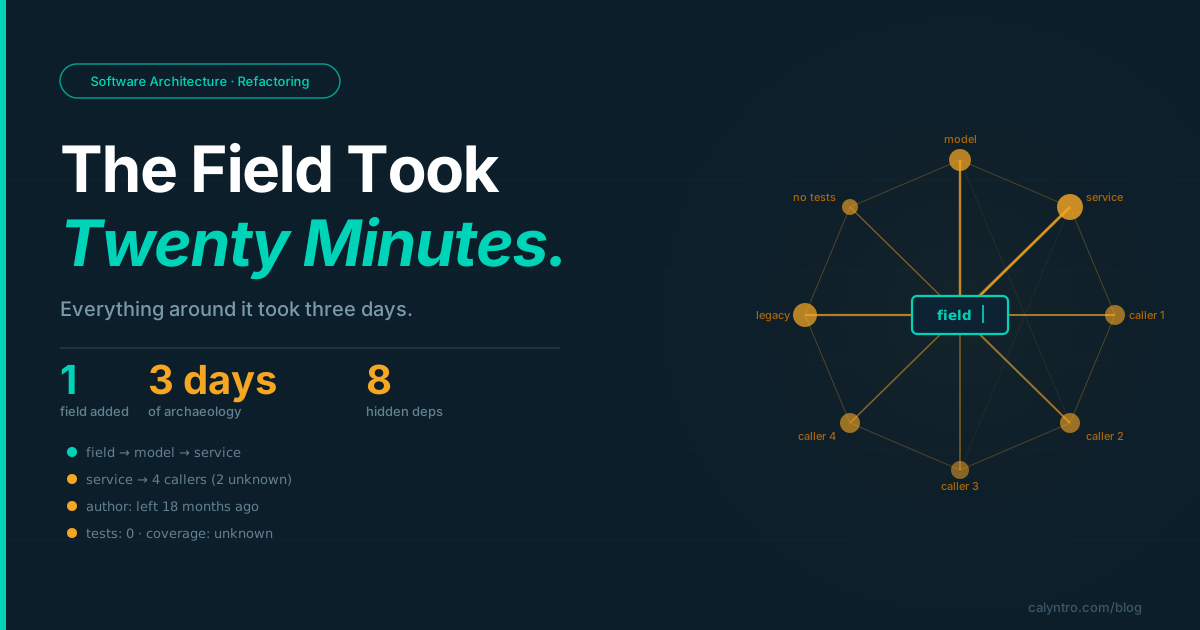
“Just add a field? It’s a 20-minute job.”
We’ve all said it. And three days later, you’re still knee-deep in a labyrinthine codebase, the ticket is still open, and your motivation has evaporated somewhere between burnout and quiet resentment.
It’s not just about the task. It’s about the feeling that you aren’t building anymore. You’re just… patching.
“Can you quickly add a field?”
You know the scenario. A stakeholder needs one extra value on a form. It lands on your desk because you’re the one who gets the changes nobody else wants to touch. An afternoon, you think.
Three days later, you’re still there.
The field touched a model. That model was wired straight into a service. That service was called from four places you didn’t know existed. No tests. Every change was a blind guess. And half the code was written by someone who left eighteen months ago, using a logic style you spent all of Tuesday just trying to decode before you dared to touch it.
The field took twenty minutes. The mess around it took three days.
It didn’t feel like engineering. It felt like waste. And the worst part? You closed that ticket feeling drained, annoyed, and quietly furious that this is what your week had become.
Small fixes are killing your architecture
The maddening part is that you can see the work you’d rather be doing. You want to step back, draw the boundaries that should have been there, untangle the core, and build something that doesn’t fight back every time you touch it.
That’s the interesting work. That’s the work that makes a difference.
But you never reach it. There’s always one more “little fix” in the way.
- Your clean, decoupled layers? They stay tangled because you never get the time to reshape.
- The codebase that could be a pleasure to work in? It remains a maze you have to relearn every time you open it.
- The architecture you can see in your head? It loses to one more “quick fix” every single sprint.
After a year, you’re working just as hard. You’re just more bored — and no closer to the system you wanted to build.
The Vicious Cycle
This isn’t bad luck. It’s not a talent gap.
Tight coupling makes every change slow and risky. Because it’s slow, you never get a clear window to fix the underlying issues — so you patch around them. Each patch wires one more thing to another, making the next change even slower.
It’s an architectural death spiral. And it’s driven by three things:
Coupling. When everything touches everything, a “small” change ripples across half the codebase.
Missing tests. Without them, every change is a jump in the dark. You can’t be bold, so you’re careful. And “careful” is slow.
Unreadable code. If understanding takes a day, you’re losing 8 hours before you’ve even typed a line.
You’re being asked to add another floor to a house with no foundation. Every new feature just makes the whole thing wobbly.
Architecture is a Business Metric, Not a Chore
This is where a senior engineer leaves a mark. Not by being a “coding wizard.” But by realizing that the shape of the system determines your velocity.
Maybe you’re thinking:
“My manager will never approve a ‘refactoring sprint.’ We have deadlines.”
And you’re right — the pressure is real. But the calculation is wrong.
Those three days you spent on a 20-minute field? They were paid for. Out of the team’s payroll, out of the delayed roadmap, and out of the next feature that will take a week longer because the next engineer has to wade through the same mess.
Tightly coupled systems aren’t free. They’re expensive. They just hide that cost in the friction of every single ticket.
When you tell your manager “I want to invest two sprints in the architecture,” it sounds like a luxury. But when you say “Every feature in this area costs us 30% more than it should because of the current coupling — and here’s how we fix that,” you’re talking about delivery speed and predictability.
You don’t need permission to redesign the system. You need the language to show what it costs not to.
You didn’t become an engineer to spend three days adding a field
But that’s what a lot of backend work has become. Not because the features are hard. But because the system makes them that way.
The real question isn’t whether you have time to fix it.
It’s whether you can afford not to.
What would happen if you stopped just patching — starting today?
The patterns that make a field take three days don’t stay hidden — they leave a trace in your git history: hotspots, change coupling, knowledge concentrated in one person. At Calyntro, we surface exactly those signals before they become your next sprint’s problem.