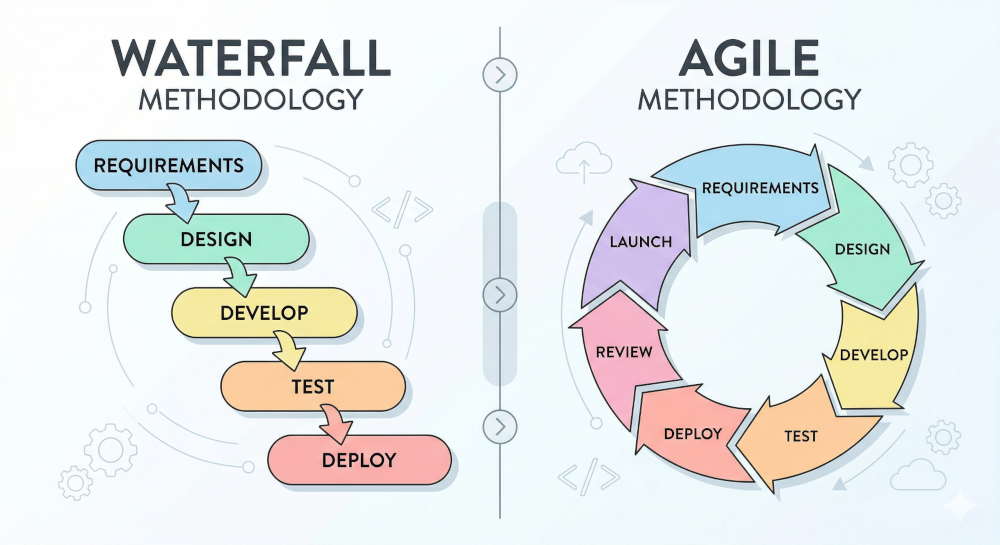
In the current era of AI-driven development, the pressure to deliver “faster” has never been higher. With the advent of sophisticated coding agents, the first instinct for many project leads is to parallelize: split the work, run frontend and backend tracks simultaneously, and maximize output.
However, this rush to parallelize often comes with a hidden cost that many organizations fail to account for. By optimizing for simultaneous output, we are inadvertently sacrificing the very Agility we claim to pursue.
The Trap: Big Upfront Design (BUFD)
The logic of parallel development is simple: if the Frontend and Backend teams work at the same time, we finish in half the time. But in software engineering, dependencies are rarely that simple.
To make parallel tracks work without constant collision, you need a complete specification from day one. You need to define the API contracts, data structures, and state management in such detail that both sides can work in a vacuum.
The paradox: To go “fast” through parallelization, you have to revert to a Waterfall-style “Big Upfront Design.”
Why Parallelization Erodes Agility
When you commit to a rigid specification early on to enable parallel work, you lose the ability to learn. Agile development is built on the principle of the Feedback Loop:
- Build a small vertical slice.
- Learn from the implementation and user interaction.
- Adjust the requirements for the next slice.
In a parallelized environment, adjusting the requirements mid-sprint is a nightmare. A minor change in the backend logic doesn’t just affect the backend; it breaks the frontend implementation that was built simultaneously. Consequently, teams tend to stick to a suboptimal plan just to avoid the “re-work” cost, effectively killing any chance of iterative improvement.
Output vs. Learning
As noted in a recent discussion sparked by the rise of coding agents, parallelizing optimizes for output, while sequential work optimizes for learning.
- Output is linear. If you build two things at once, you have two things.
- Learning is compound. What you learn while building the backend might fundamentally change how you should approach the frontend to provide a better user experience.
If we use AI agents simply to execute parallel tracks faster, we aren’t becoming more agile—we are just building rigid systems at a higher velocity.
Finding the Balance
Does this mean we should never work in parallel? Of course not. But we must be conscious of the trade-off.
The most effective teams focus on Vertical Slices. Instead of “Backend vs. Frontend,” they focus on “Feature A.” They build the minimal necessary backend and frontend for that feature in tight, small-scale loops. This allows the architecture to evolve naturally and ensures that the specification stays as lean as possible.
Conclusion
Speed is not measured by how many lines of code we can generate simultaneously. True speed is measured by how quickly we can reach a viable, high-quality solution that meets the user’s needs.
If your parallelization strategy requires a 50-page specification document before a single agent starts coding, you aren’t doing Agile. You’re doing Waterfall with a faster engine.
This post was inspired by a recent discussion on LinkedIn regarding the use of AI coding agents in project planning.