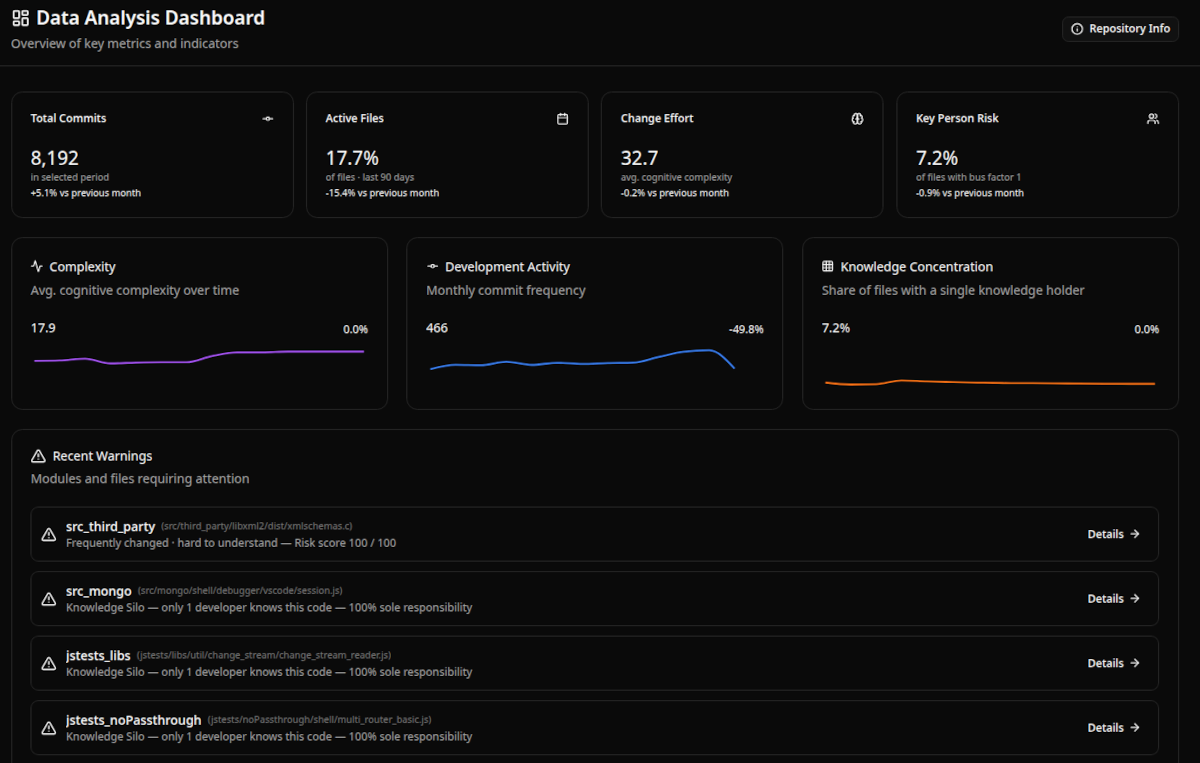
Most tools that claim to show code ownership answer one question: who last touched this file?
It is a reasonable question. But it is the wrong one.
A file can have five contributors on record — and still be fully owned by someone who left the company fourteen months ago. The commit history looks healthy. The risk is invisible.
This is the gap Calyntro is built to close.
The Difference: Static vs. Temporal Ownership
Standard ownership tools take a snapshot. They look at the current state of the repository and assign files to whoever touched them most recently, or most often, within a fixed window.
That snapshot misses something critical: time.
Calyntro tracks what we call temporal ownership — who wrote the code, when they wrote it, whether they are still active in that module, and whether anyone else has built real understanding of it since. A developer who wrote 80% of a module two years ago and left eighteen months ago still shows up. Not as an active contributor — but as a knowledge gap.
The question is not “who owns this file today?” It is “who would be left holding it if the person who built it walked out the door tomorrow?”
What Calyntro Measures
Silo Ratio The share of files in a module where a single developer holds exclusive knowledge. A silo ratio of 100% means one person is the sole knowledge holder for every file in that module — no backup, no redundancy.
Bus Factor The number of people whose departure would immediately create a knowledge gap. A bus factor of 1 is a single point of failure.
Churn Rate How actively a module is changing. High churn combined with high silo risk is the most dangerous combination: the code is evolving constantly, and only one person understands it.
Knowledge Risk Score A combined metric that weights silo ratio, churn, and the activity status of knowledge holders. It surfaces modules that need attention — before a departure forces the issue.
What This Looks Like in Practice
We ran Calyntro on the MongoDB open-source repository — one of the most professionally maintained codebases in the world. Structured contribution guidelines, active code review, long-term maintainers.
Here is what we found:
- 17 of 43 modules show measurable knowledge risk
- 2 modules at 100% silo risk — no distributed ownership, no meaningful backup
- 1 developer holds exclusive knowledge of 161 files in a single module
- The module with the highest churn rate carries a 38.2% silo risk
This is not a startup with three engineers and no processes. This is MongoDB. If knowledge risk shows up here, it shows up everywhere.
What Standard Tools Would Show
A static ownership snapshot of the same repository would show something different. It would show active contributors, recent commits, files touched in the last 90 days.
It would not show the developer who wrote the core of src_third_party over a two-year period and is no longer actively contributing. It would not flag the module where every meaningful architectural decision was made by one person. It would not tell you that the highest-activity module also has the highest knowledge concentration.
The snapshot looks clean. The risk is structural.
How Calyntro Works
Calyntro reads the Git history of your repository — nothing else.
No code leaves your system. No agents. No instrumentation. No access to your source files beyond what is recorded in commits and authorship metadata.
The analysis runs against your Git history and returns a structured view of where knowledge lives, where it is concentrated, and where it is at risk.
For private repositories, Calyntro runs self-hosted in your infrastructure. The data never leaves your network.
Try It
We have a live demo running against the MongoDB repository at demo.calyntro.com. You can explore the full analysis — modules, risk scores, key persons, and the hotspot heatmap.
If you are curious what these numbers look like in your own codebase, get in touch.
Calyntro is a repository intelligence platform for engineering teams and leadership. Developer names in all analyses are anonymised.