The Last Mile Problem – Awareness is not Governance

The Last Mile Problem in AI-Assisted Development

We have spent the last year solving the during problem in AI-assisted development. How do we work alongside AI without losing architectural coherence? How do we structure teams so that the speed of AI generation does not outrun human judgment? How do we ensure that the conceptual identity of a system — the thing only humans can define — survives contact with an LLM that has never read the architecture decision records? ...

May 31, 2026 · 5 min · Karl-Heinz Reichel
SDD and the Missing Half — knowledge evaporation in agentic development

SDD and the Missing Half of the Answer

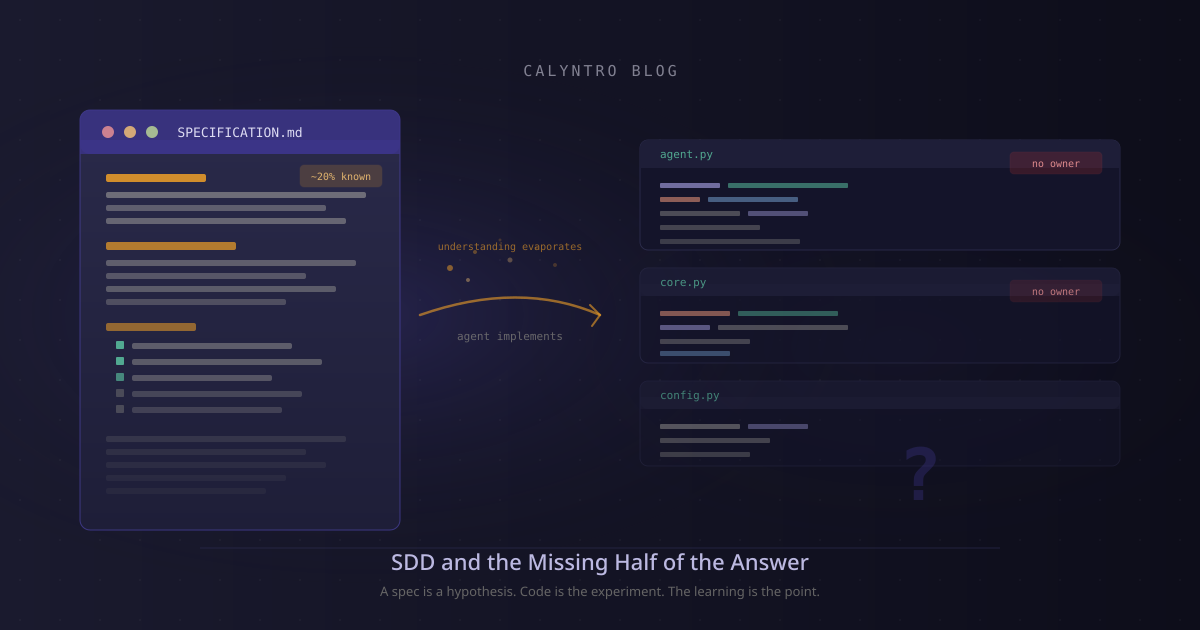
Adam Tornhill published a piece today that I found myself nodding along to almost paragraph by paragraph. His argument: Spec-Driven Development, in its strong form, is a replay of the Model-Driven Architecture dream from the 1990s — and it will fail for the same reasons. Implementation is not the execution of a known scope. It is the discovery of scope that wasn’t known yet. He’s right. And I want to pick up where he stops. ...

May 28, 2026 · 4 min · Karl-Heinz Reichel
What Calyntro Measures — temporal ownership, silo risk, and knowledge gaps in your codebase

What Calyntro Measures — And Why Standard Tools Miss It

Most tools that claim to show code ownership answer one question: who last touched this file? It is a reasonable question. But it is the wrong one. A file can have five contributors on record — and still be fully owned by someone who left the company fourteen months ago. The commit history looks healthy. The risk is invisible. This is the gap Calyntro is built to close. The Difference: Static vs. Temporal Ownership Standard ownership tools take a snapshot. They look at the current state of the repository and assign files to whoever touched them most recently, or most often, within a fixed window. ...

May 26, 2026 · 4 min · Karl-Heinz Reichel
The Architecture Is Too Late – Coherence is built upstream, not refactored into chaos

From Chaos to Coherence: What AI Cannot Do for Your Architecture

In my previous post, I argued that full specification fails with AI — and that component-based architecture with clear interfaces is the right model. Since then, several readers pointed me to a similar argument by Javi Lopez, who draws a sharp parallel to the CASE tools of the late 1980s: the same promise, the same illusion, a new mask. Lopez is right. And I want to go one step further — not just to say what goes wrong, but to show what it looks like when it goes wrong, and what it takes to recover. ...

May 25, 2026 · 5 min · Karl-Heinz Reichel
The Review Is Too Late – Karl-Heinz Reichel

The Review Is Too Late

There is a conversation happening right now in engineering circles about code reviews. The argument goes roughly like this: AI is generating code faster than humans can review it, PR volume is exploding, and we need smarter tooling to keep up. That argument is correct. And it is solving the wrong problem. The deeper issue is not that reviews don’t scale. It is that we are still treating the review as the primary quality gate — a last line of defence before code enters the codebase. In the age of AI-assisted development, that assumption needs to be challenged at its root. ...

May 20, 2026 · 6 min · Karl-Heinz Reichel
ai_programming_in_threes

Why We Code in Threes

Over the past months, a question has been making the rounds in engineering circles: Is anyone doing “triplet programming” — two humans and an AI agent? We are. Here is why. The Setup When we introduced GitHub Copilot as an agentic coding assistant, the default assumption was that each developer would work one-on-one with the agent. That is not what we ended up doing. Instead, we run sessions with two developers and one agent. ...

May 15, 2026 · 4 min · Karl-Heinz Reichel
Knowledge concentration heatmap across a codebase

What We Found When We Analysed MongoDB's Codebase

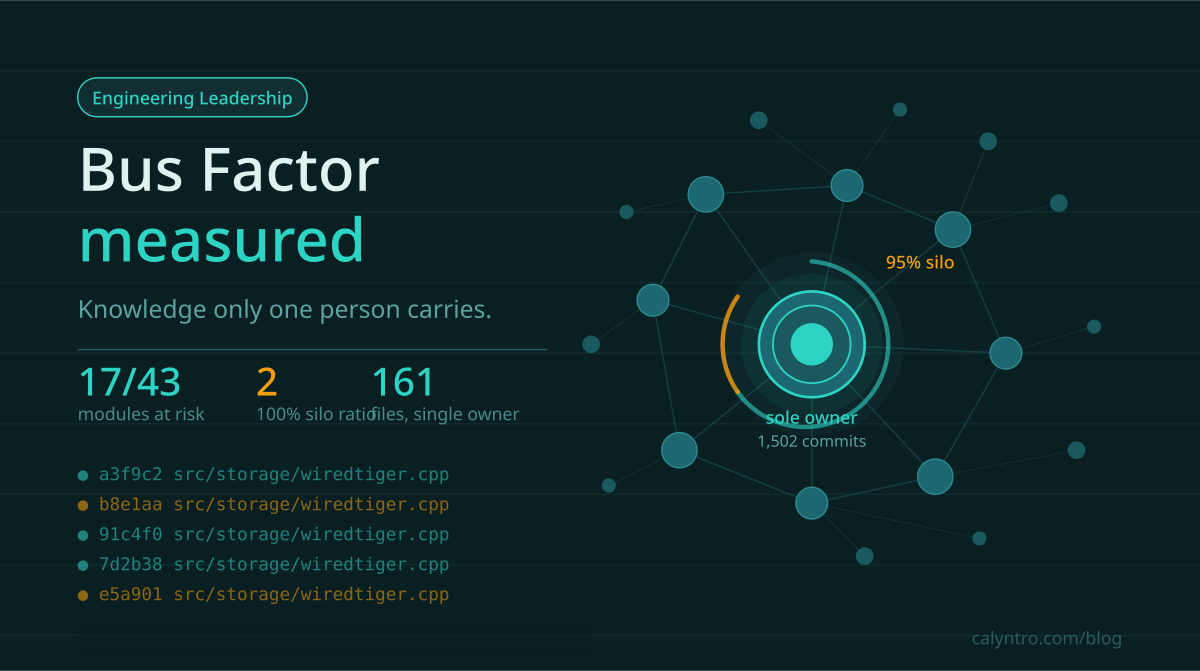
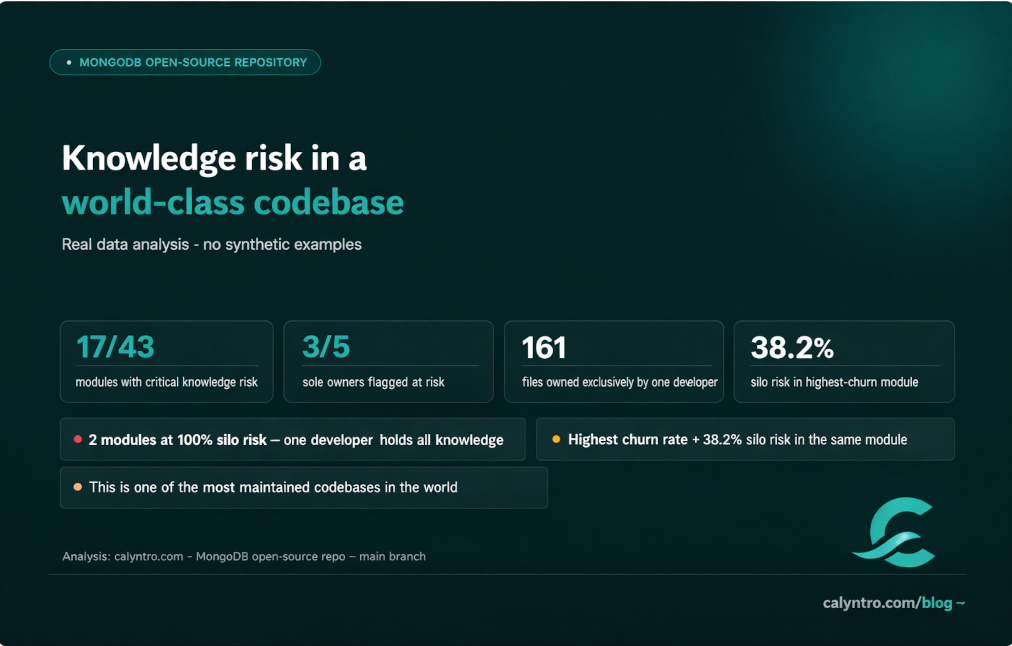
One developer. 161 files. The highest churn rate in the entire repository. This is not a startup with three engineers and no processes. This is MongoDB — one of the most widely used, most professionally maintained open-source codebases in the world. Thousands of contributors. Years of accumulated engineering discipline. And still: a single person holds exclusive knowledge of 161 files in a module that changes more than any other. Why MongoDB? We chose MongoDB deliberately. Not because it is a cautionary tale, but because it is the opposite: a project that does almost everything right. Structured contribution guidelines, active code review, long-term maintainers. If knowledge risk shows up here, it shows up everywhere. ...

May 13, 2026 · 5 min · Karl-Heinz Reichel
Knowledge concentration heatmap across a codebase

The Invisible Risk in Your Codebase

Three months’ notice sounds like enough time. It isn’t. Not for the files nobody else has ever touched. Not for the modules where one person made every decision for the last two years. You discover those files during the handover. Or after it. We call it a knowledge transfer problem. It isn’t one. It’s a visibility problem. What bus factor actually means The term comes from a thought experiment: how many people on your team would need to be hit by a bus before the project is in serious trouble? ...

April 30, 2026 · 4 min · Karl-Heinz Reichel
ai ready architecture_header

Why AI Cannot Handle Full Specifications – and How Architecture with AI Really Works

Over the past months, I have experimented extensively with using AI in software and system architecture. One pattern became increasingly clear: We try to use AI like a compiler. We assume that if we specify enough, the AI should be able to generate an entire system. But this approach fails consistently. Not because AI is “too dumb” — but because we are using the wrong model. In this article, I explain why full specification does not work with AI and which architectural model does. ...

April 20, 2026 · 3 min · Karl-Heinz Reichel
parallelization_paradox_header

The Parallelization Paradox: Why Speed is Killing Your Agility

In the current era of AI-driven development, the pressure to deliver “faster” has never been higher. With the advent of sophisticated coding agents, the first instinct for many project leads is to parallelize: split the work, run frontend and backend tracks simultaneously, and maximize output. However, this rush to parallelize often comes with a hidden cost that many organizations fail to account for. By optimizing for simultaneous output, we are inadvertently sacrificing the very Agility we claim to pursue. ...

April 10, 2026 · 3 min · Karl-Heinz Reichel