Nobody Chose BSUF. You Just Followed the Path of Least Resistance.

Nobody Chose BSUF. You Just Followed the Path of Least Resistance.

Big Spec Up Front failed. Not because the people who practiced it were careless — many of them were meticulous. It failed because of something structural: the act of implementation always reveals things that specification missed. Users cannot fully articulate what they want before they see it. Complexity defeats even complete knowledge. External requirements shift before the system ships. Agile was the response. Short loops. Working software over comprehensive documentation. Iterate toward understanding instead of specifying toward it. ...

June 30, 2026 · 7 min · Karl-Heinz Reichel
Two Doors, One Gate: Navigating Governance Beyond EDD

Two Doors, One Gate: Navigating Governance Beyond EDD

Two Doors, One Gate Onboarding guardrails and power-user friction look like the same problem. They aren’t. June 2026 · 7 min · Karl-Heinz Reichel Table of Contents The Setup The Category Error We Already Made Once Two Layers, Not One Document Letting the Data Set the Threshold Accountability Instead of a Badge Closing Thought A few weeks ago we wrote about why we run AI coding sessions with two developers instead of one. Triplet programming works well as a transitional structure — a way to build shared fluency while the risk of agent-driven, codebase-wide changes is still high. ...

June 28, 2026 · 9 min · Karl-Heinz Reichel
EDD Closes the Loop — But Only Half of It

EDD Closes the Loop — But Only Half of It

A recent piece by Andrea Laforgia on Expectation-Driven Development (EDD) made the rounds, and it deserves serious attention. The core argument is compelling: AI agents produce code faster than humans can meaningfully review it, so we need a structured protocol for specifying intent before implementation and demanding evidence of fulfillment afterward. The human developer transitions from author to editor — from writing code to evaluating it. That framing is right. And the EDD workflow — write expectations in plain text, let the agent implement, ask the agent to prove it, challenge the evidence, iterate — is a real improvement over the current default, which is roughly “trust and hope the CI is green.” ...

June 20, 2026 · 8 min · Karl-Heinz Reichel
The Last Mile Problem – Awareness is not Governance

The Last Mile Problem in AI-Assisted Development

We have spent the last year solving the during problem in AI-assisted development. How do we work alongside AI without losing architectural coherence? How do we structure teams so that the speed of AI generation does not outrun human judgment? How do we ensure that the conceptual identity of a system — the thing only humans can define — survives contact with an LLM that has never read the architecture decision records? ...

May 31, 2026 · 5 min · Karl-Heinz Reichel
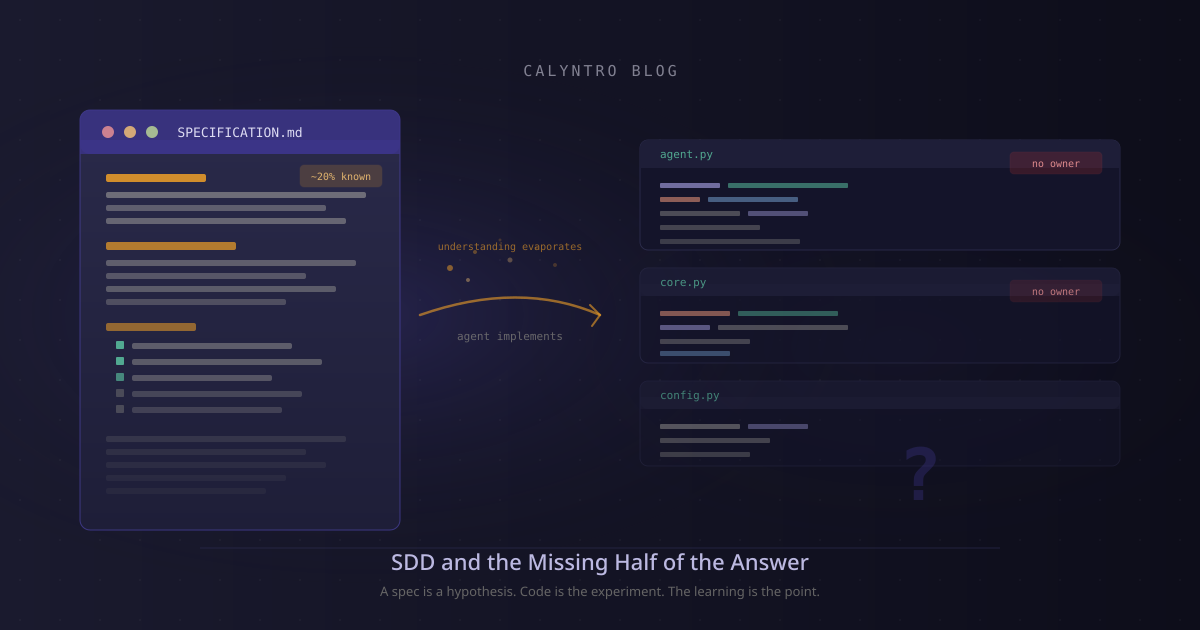
SDD and the Missing Half — knowledge evaporation in agentic development

SDD and the Missing Half of the Answer

Adam Tornhill published a piece today that I found myself nodding along to almost paragraph by paragraph. His argument: Spec-Driven Development, in its strong form, is a replay of the Model-Driven Architecture dream from the 1990s — and it will fail for the same reasons. Implementation is not the execution of a known scope. It is the discovery of scope that wasn’t known yet. He’s right. And I want to pick up where he stops. ...

May 28, 2026 · 4 min · Karl-Heinz Reichel
The Architecture Is Too Late – Coherence is built upstream, not refactored into chaos

From Chaos to Coherence: What AI Cannot Do for Your Architecture

In my previous post, I argued that full specification fails with AI — and that component-based architecture with clear interfaces is the right model. Since then, several readers pointed me to a similar argument by Javi Lopez, who draws a sharp parallel to the CASE tools of the late 1980s: the same promise, the same illusion, a new mask. Lopez is right. And I want to go one step further — not just to say what goes wrong, but to show what it looks like when it goes wrong, and what it takes to recover. ...

May 25, 2026 · 5 min · Karl-Heinz Reichel
ai_programming_in_threes

Why We Code in Threes

Over the past months, a question has been making the rounds in engineering circles: Is anyone doing “triplet programming” — two humans and an AI agent? We are. Here is why. The Setup When we introduced GitHub Copilot as an agentic coding assistant, the default assumption was that each developer would work one-on-one with the agent. That is not what we ended up doing. Instead, we run sessions with two developers and one agent. ...

May 15, 2026 · 4 min · Karl-Heinz Reichel
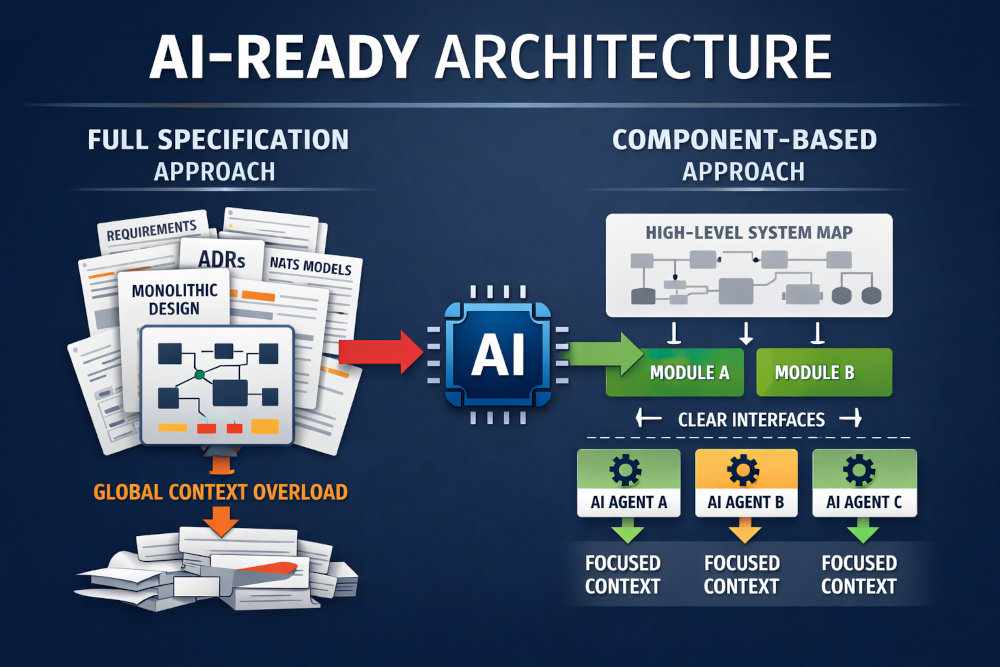
ai ready architecture_header

Why AI Cannot Handle Full Specifications – and How Architecture with AI Really Works

Over the past months, I have experimented extensively with using AI in software and system architecture. One pattern became increasingly clear: We try to use AI like a compiler. We assume that if we specify enough, the AI should be able to generate an entire system. But this approach fails consistently. Not because AI is “too dumb” — but because we are using the wrong model. In this article, I explain why full specification does not work with AI and which architectural model does. ...

April 20, 2026 · 3 min · Karl-Heinz Reichel